There’s a phrase I’ve coined and use half-jokingly with my partner: “the desperate quest for joy.” And, every now and then, we will note when something strikes us as a “desperate quest for joy.” One example of this is the Thanksgiving-themed toilet cover (with matching hand towels). Any over-the-top or superfluous holiday decorations obviously qualify as desperate-quests-for-joy. You don’t have to show us how much fun you should be having, just have it.
I think of this this morning because I read a Facebook status of one of my friends from high school. In high school I had imagined what a great artistic force she would become, how she’d take the world by storm. I had admired her free poetic spirit, and somewhat envied it in her. Years later, after no contact, we find each other on Facebook and I was dismayed to learn that she really hadn’t been doing anything particularly poetically-adventurous. She worked in her dad’s office for most the years after college and is now a mother of two while she teaches ‘baby yoga’ (I haven’t the slightest notion of what that looks like) part-time. In school, she stood out in my mind as one who was extraordinary, one who wasn’t afraid to think and behave differently from others, and how she did it was simply… beautiful.
It is beautiful to find love, marry, become a mother – yes.
Nearly everyday, she’s updates her FB status, something to the quasi-poetic effect of: Dirty dishes in the sink. Lovely babies smelling like green grass and the Earth. My husband is my hero. I love my life! Or: A sleepy end to a wonderful day. Beautiful baby crying won’t let me rest. I love my life! Or: I love my home. I love my SUV. I love that my husband’s business is strong. I love my life!
Do you hear it, everybody? She loves her life. In case you ever had any doubt as to whether she enjoys her life, then you may now put it aside. Life affirmation is a healthy thing to do. It keeps us from taking our blessings for granted. But it comes to the point when it seems like we spend more time making these ‘affirmations’ than living them. It makes me wonder, then if, when we do this, we are not in the moment of enjoying these blessings. Instead, we’re busy showing others how we’re enjoying the blessings, busy constructing the pretense of enjoyment.
I think we could say the same for excessive social drinking. Or excessive holiday-taking. Or excessive toy-consuming.
This is not a criticism, show much as an alert. It’s likely that behind this pretense of enjoyment is a soul who is lonely and suffering. Behind this pretense of enjoyment is an identity un-realized and unacknowledged. This person is MORE, much more, than the sum of their symbols of joy. On some level, this person knows it and is trying to forget. Maybe we haven’t shown enough interest.
Friday, September 25, 2009

Monday, September 21, 2009
Parents and Children - Depression
There seems to be more pressure on the child to make the parents happy than for the parents to make the child happy. For example, if the parent is feeling dejected, suffering from low self-esteem or depression, the child feels unbearable responsible. The child feels guilty and is desperate to find ways to make the parent happy again. The child is more likely to forego their own objectives, sacrificing their own opportunity for happiness, doing everything in their power to make a suffering parent happy.
However, if the child is depressed, the parent chalks is up to the consequence of the child’s bad choices (including the choice of bad friends or bad wives who lead the child astray) or even to some naturally-occurring personality flaw. It seems the parent is more likely to leave him be, send him to a therapist, shower him with things, or even abandon him.
The child, on the other hand, will ask himself first what he had done to cause his parent such distress, and then come up with ever conceivable way to make this person happy, even if it means turning down great career opportunities that would take him far from his parent. The child continues to beat himself up for as long as the parent appears to be sad.
The uncanny thing about this situation is that the child is probably the last person capable of helping the parent, while the parent is the first person capable of helping the child out of his depression. Depression is borne out of low self-esteem and loneliness. And I tend to think that the first companion/soul mate a person knows is his parent. This is fundamental to the child’s sense of self. I wonder if the bond with one’s child is as crucial to the parent’s sense of self. The child’s love, I think, may enhance a parent’s self-esteem, but I don’t think the parent’s self-esteem is dependent on it.
This may be a gross generalization about depression. It’s only a theory I’m working on based on my observations and experiences.
However, if the child is depressed, the parent chalks is up to the consequence of the child’s bad choices (including the choice of bad friends or bad wives who lead the child astray) or even to some naturally-occurring personality flaw. It seems the parent is more likely to leave him be, send him to a therapist, shower him with things, or even abandon him.
The child, on the other hand, will ask himself first what he had done to cause his parent such distress, and then come up with ever conceivable way to make this person happy, even if it means turning down great career opportunities that would take him far from his parent. The child continues to beat himself up for as long as the parent appears to be sad.
The uncanny thing about this situation is that the child is probably the last person capable of helping the parent, while the parent is the first person capable of helping the child out of his depression. Depression is borne out of low self-esteem and loneliness. And I tend to think that the first companion/soul mate a person knows is his parent. This is fundamental to the child’s sense of self. I wonder if the bond with one’s child is as crucial to the parent’s sense of self. The child’s love, I think, may enhance a parent’s self-esteem, but I don’t think the parent’s self-esteem is dependent on it.
This may be a gross generalization about depression. It’s only a theory I’m working on based on my observations and experiences.
Wednesday, September 16, 2009
Follow Up to "Feelin' the tug"
Immediately after finishing yesterday’s post I was compelled to write the person in question to ask her if she wanted to meet for coffee some time this week. She wrote back a long message about how she’s grateful to hear from me because she has recently been betrayed by a couple of other people whom she had considered friends. It had come to her attention that they were going around calling her "an attention whore." In the email she proceeded to tell me that she wouldn’t be able to make any promises for an engagement this week as her poor health has been exacerbated of late and listed all the health issues that are currently plaguing her—things that I was already well-aware of. Anyone who knows her is well-aware of her many physical ailments.
In a two-line response I suggested that we aim to get together early next week as I’m looking forward to catching up with her.
In response, she said that she’ll have to let me know on Monday as to whether Tuesday or Wednesday will work for her. Her debilitating pains come on randomly. She added that the forecast for ‘bad’ weather (cloudy with risk of showers) also factors into the probability of whether she'll make it out her front door.
This person once kept me waiting an hour at a coffee shop for her before I gave up and went home. I arrived home to an email from her sent while I was at the coffee shop in which she apologized for her failure to meet me: her ailments had kept her up the night before, causing her to sleep in. We had agreed to meet at 1pm. She had sent the email about 1:20. She lives about 15 minutes away from the coffee shop, as do I. I can’t help but feel I was set up to be disappointed and she had set herself up to fail. When social engagements come so few and far between, one would think that when an opportunity for one comes up one would make the effort to show up for it. I mean, her failure to show up showed a total disregard for the effort I had made. (I learned recently that she had stood up another mutual acquaintance in the same way.)
But, as I wrote yesterday, I had been feeling “torn” as to whether I should make more efforts to be a friend to this person. Writing yesterday’s blog gave me the clue as to what to do and I did it.
The latest message from her (which, by the way, was about 5 times the length of mine, as they always are) listed (again) all the ailments that have been causing her depression lately. She also said she wonders if she should bother cultivating relationships because her health keeps her back from socializing normally and because she worries that she may bore or annoy others with her constant talk of it. It’s true—this has repulsed countless people I know.
And then, it occurred to me: she doesn’t really want a friend. For a friend, one would have to make an effort. In order to have a friend, as the saying goes, you have to be a friend. She hasn’t been a friend. She hasn’t really tried. Never once, including in this recent email exchange, has she asked me how I’m doing. I believe she thinks by constantly saying things like how I’m “so understanding,” “amazing,” “one of the most wonderful people” she’s met in this city, it’s enough to keep my attention. It’s manipulative. It's what had forced me into this feeling of being “torn," asking myself, how could I possibly be so dismissive of her when she’s been nothing but admiring of me? Ha! She has bought into the notion that ‘flattery gets you everywhere’. But flattery is just that—words. Without deeds to back it up, i.e. expressing care, they’re empty ones.
As I’ve said, she doesn’t want a friend. What she wants, rather, is an audience. This is why Facebook works for her. She can write these dire status updates hoping that it might scare us into attention. She to keep us on our toes, to leave in such a state of shock that we can't bring ourselves to change the channel (or un-Friend her or “hide” her updates, as it were). She also uses her status updates to blast her Facebook 'friends' for not paying attention to her, for not responding to her profuse posts.
I may have written yesterday that I shouldn’t hesitate to share energy (love, care, attention) with some from whom I don’t expect to be reciprocated. But in this case, I’m not sure I want to put myself in a situation in which I’d be completely effaced. And to put myself in a situation in which I’d be effaced would be to disrespect myself.
She wants an audience and not a friend: she does have a performer’s streak in her. She fancies herself a singer, telling us often of her one opportunity to sing in Madison Square Garden. She recently performed at a local burlesque show, adopting a stage name which now goes by on Facebook. (If I were to meet her for coffee, I wouldn't be sure as to which name to call her.) All over the Internet, she posts photo upon photo of herself in the past and in the present--"me with the New Wave spandex look," "me on morphine and percaset, but you wouldn't know it"-- as well as videos of her riding her biking to the Whole Foods and videos of her biking from Whole Foods.
This idea of existing only on the Internet, a forum where you can be whomever you want to be, where you can put yourself on display and have as much or as little interaction with others as you choose, reminds me of The Wrestler, the fantastic Mickey Rourke film I had recently seen. In it, Mickey plays an aging—possibly dying -- wrestler who is unable to crossover from the artificial world of professional wrestling to the real world of relationships, responsibilities, commitment, and hard work. It's the world where ‘acting’ or ‘performing’ won’t get you very far, where your efforts have to be actual, not pretend.
I had thought all her Internet activity was the expression of her loneliness and depression, but now I wonder if the loneliness and depression are the result of this life-in-performance. On the Internet, as in the wrestling ring, the image of any persona you’ve fashioned is preserved.
In this world, it's effort--not image--that matters.
In a two-line response I suggested that we aim to get together early next week as I’m looking forward to catching up with her.
In response, she said that she’ll have to let me know on Monday as to whether Tuesday or Wednesday will work for her. Her debilitating pains come on randomly. She added that the forecast for ‘bad’ weather (cloudy with risk of showers) also factors into the probability of whether she'll make it out her front door.
This person once kept me waiting an hour at a coffee shop for her before I gave up and went home. I arrived home to an email from her sent while I was at the coffee shop in which she apologized for her failure to meet me: her ailments had kept her up the night before, causing her to sleep in. We had agreed to meet at 1pm. She had sent the email about 1:20. She lives about 15 minutes away from the coffee shop, as do I. I can’t help but feel I was set up to be disappointed and she had set herself up to fail. When social engagements come so few and far between, one would think that when an opportunity for one comes up one would make the effort to show up for it. I mean, her failure to show up showed a total disregard for the effort I had made. (I learned recently that she had stood up another mutual acquaintance in the same way.)
But, as I wrote yesterday, I had been feeling “torn” as to whether I should make more efforts to be a friend to this person. Writing yesterday’s blog gave me the clue as to what to do and I did it.
The latest message from her (which, by the way, was about 5 times the length of mine, as they always are) listed (again) all the ailments that have been causing her depression lately. She also said she wonders if she should bother cultivating relationships because her health keeps her back from socializing normally and because she worries that she may bore or annoy others with her constant talk of it. It’s true—this has repulsed countless people I know.
And then, it occurred to me: she doesn’t really want a friend. For a friend, one would have to make an effort. In order to have a friend, as the saying goes, you have to be a friend. She hasn’t been a friend. She hasn’t really tried. Never once, including in this recent email exchange, has she asked me how I’m doing. I believe she thinks by constantly saying things like how I’m “so understanding,” “amazing,” “one of the most wonderful people” she’s met in this city, it’s enough to keep my attention. It’s manipulative. It's what had forced me into this feeling of being “torn," asking myself, how could I possibly be so dismissive of her when she’s been nothing but admiring of me? Ha! She has bought into the notion that ‘flattery gets you everywhere’. But flattery is just that—words. Without deeds to back it up, i.e. expressing care, they’re empty ones.
As I’ve said, she doesn’t want a friend. What she wants, rather, is an audience. This is why Facebook works for her. She can write these dire status updates hoping that it might scare us into attention. She to keep us on our toes, to leave in such a state of shock that we can't bring ourselves to change the channel (or un-Friend her or “hide” her updates, as it were). She also uses her status updates to blast her Facebook 'friends' for not paying attention to her, for not responding to her profuse posts.
I may have written yesterday that I shouldn’t hesitate to share energy (love, care, attention) with some from whom I don’t expect to be reciprocated. But in this case, I’m not sure I want to put myself in a situation in which I’d be completely effaced. And to put myself in a situation in which I’d be effaced would be to disrespect myself.
She wants an audience and not a friend: she does have a performer’s streak in her. She fancies herself a singer, telling us often of her one opportunity to sing in Madison Square Garden. She recently performed at a local burlesque show, adopting a stage name which now goes by on Facebook. (If I were to meet her for coffee, I wouldn't be sure as to which name to call her.) All over the Internet, she posts photo upon photo of herself in the past and in the present--"me with the New Wave spandex look," "me on morphine and percaset, but you wouldn't know it"-- as well as videos of her riding her biking to the Whole Foods and videos of her biking from Whole Foods.
This idea of existing only on the Internet, a forum where you can be whomever you want to be, where you can put yourself on display and have as much or as little interaction with others as you choose, reminds me of The Wrestler, the fantastic Mickey Rourke film I had recently seen. In it, Mickey plays an aging—possibly dying -- wrestler who is unable to crossover from the artificial world of professional wrestling to the real world of relationships, responsibilities, commitment, and hard work. It's the world where ‘acting’ or ‘performing’ won’t get you very far, where your efforts have to be actual, not pretend.
I had thought all her Internet activity was the expression of her loneliness and depression, but now I wonder if the loneliness and depression are the result of this life-in-performance. On the Internet, as in the wrestling ring, the image of any persona you’ve fashioned is preserved.
In this world, it's effort--not image--that matters.
Tuesday, September 15, 2009
Feelin' the tug
I feel torn as to what to do. I hate to willfully neglect someone I know is in need—lonely, desperate for acknowledgment. And I used to tell myself, since experiencing a period of desperate loneliness myself, that no one I know will ever know loneliness; I vowed that I would be there for this person no matter what. And from what I had learned through my reading of Shakespeare’s All’s Well that Ends Well, we need others—people need other people—in order to become their best selves. No one can give love and generosity unless they have received love and generosity from others. And I am reminded of one of my favourite books from my undergraduate years, a book that I had sworn had change my life—E.M. Forster’s Howard’s End and the admonition to “only connect.”
Connecting requires energy. And maybe I don’t feel I have the energy to be there for this person. Maybe I’m not connecting enough in general. I have things going on myself—waiting on my green card, feeling creatively blocked, in a mode of conserving funds. On some level, I guess I think that because I’m not weighing others down with my burdens no one should expect the same of me… right now. When I doing swimmingly… then, by all means, come to me, I’ve got great pair of shoulders and a couple of bon mots to match!
But is this really how this should work? What if I were to think of this in terms of energy and energy conservation and how much I have to expend at the moment for this or any other person? If I conserve my energy for dealing with my issues, I draw I expend only the energy that I contain and there is no flow. There is no energy passing through me, only coming from me.
And what if I were to open up the walls of my chamber and let the energy flow out to this other person at the risk of emptying myself out? The energy is transferred from myself to this other person. She opens up the walls of her chamber to let it in. Then what? Does she vampiricly suck me dry of my energy so that I have none left for myself and the things I have to deal with? I wonder if it does work this way. Does it depend on the person I give my energy to?
I go back to All’s Well and Parolles. How could he have learned generosity and humaneness if he’s never witnessed it, never been a recipient of it?
And, I think about a certain principle I’ve been preaching to my girlfriends: you get back what you give. You may not get it back from the person you gave it to, but it comes back to you—even if it’s from another direction. I’ve urged them to have faith in this principle (now that I think of it, I’m not exactly sure why), and now I can see why this had been so difficult to digest. Right now, I’m not sure I can digest it myself!
What the hell. I’ll try it, and I’ll let you know how it turns out.
Connecting requires energy. And maybe I don’t feel I have the energy to be there for this person. Maybe I’m not connecting enough in general. I have things going on myself—waiting on my green card, feeling creatively blocked, in a mode of conserving funds. On some level, I guess I think that because I’m not weighing others down with my burdens no one should expect the same of me… right now. When I doing swimmingly… then, by all means, come to me, I’ve got great pair of shoulders and a couple of bon mots to match!
But is this really how this should work? What if I were to think of this in terms of energy and energy conservation and how much I have to expend at the moment for this or any other person? If I conserve my energy for dealing with my issues, I draw I expend only the energy that I contain and there is no flow. There is no energy passing through me, only coming from me.
And what if I were to open up the walls of my chamber and let the energy flow out to this other person at the risk of emptying myself out? The energy is transferred from myself to this other person. She opens up the walls of her chamber to let it in. Then what? Does she vampiricly suck me dry of my energy so that I have none left for myself and the things I have to deal with? I wonder if it does work this way. Does it depend on the person I give my energy to?
I go back to All’s Well and Parolles. How could he have learned generosity and humaneness if he’s never witnessed it, never been a recipient of it?
And, I think about a certain principle I’ve been preaching to my girlfriends: you get back what you give. You may not get it back from the person you gave it to, but it comes back to you—even if it’s from another direction. I’ve urged them to have faith in this principle (now that I think of it, I’m not exactly sure why), and now I can see why this had been so difficult to digest. Right now, I’m not sure I can digest it myself!
What the hell. I’ll try it, and I’ll let you know how it turns out.
Monday, September 14, 2009
addendum to previous post
I guess it means that if we love our mates, we love them for who they as well as who they will become.
Upon thinking of my friends
When our dreams our deferred, we become disappointed, withdrawn, and despondent. When our dreams are deferred by those whom we love most, those with whom we share our lives, our despondence turns to resentment and anger. Anger, like love, can never be idle, isolated, unshared. And anger, like a hunter, ravenously preys on others to feed itself.
It hurts me to observe unexpressed anger between a husband and wife, especially when the husband and wife happen to be friends of mine. This is what inspires this post today.
If there’s anyone in the world – a single person – who we expect to help us in pursuing our dreams, it is our life partner. When we depend on this person’s love, we expect love for one’s self and everything that comes from one’s self. Our dreams are Us. They are what inform our truest selves. Our best selves. The selves we are meant to be.
We tend take for granted the person we know, the person we think we know. But this other person is an organic being, who not only grows and transforms physically, but also intellectually, spiritually, and emotionally. We don’t meet our partners when they have achieved their best selves, when they are fully realized because, for one thing, finally meeting and falling in love with you is part of their process of self-actualization. Popular psychotherapy might suggest you do find this fully idealized self. Popular psychotherapy, whether in the form of a Cosmo article or the trained professional in front of you, reminds you to seek out those who present the symbols of full self-actualization – or symbols of what has been summarily dubbed ‘success’ – like the car, the job, the mortgage. But when we reduce a potential mate to these symbols we also undermine humanity and human potential, the potential for greatness.
Therefore, if this person to whom you’re married is ever transformative, you are too. We are by nature ever growing, ever evolving toward our best selves. Nothing in Nature is without purpose. How can a sunflower seed have any more destiny for beauty, i.e. greatness, than humans have? How can a tomato plant have a more determined purpose than we do? I’m reminded of that moment in Fellini’s La Strada, when she looks at the little pebble and acknowledges that it has a purpose on this Earth. She doesn’t know if the pebble has already or is yet to serve its purpose on the planet it shares with her, but she revels in the notion that it does have one. How can it have any more purpose than you, or I, or that jerk who failed to hold the elevator for us?
Why “destiny”? What does it matter? Who needs it? This is perhaps why: we don’t need to wait for The Afterlife to live in Paradise. Eternity is now. This is it. We can realize Heaven here. It is a Heaven where we live in harmony within ourselves and with out ourselves among others.
It’s in taking our husband or wife for granted and taking for granted our ‘knowledge’ of him or her that we stunt them. Our purpose as husband and as wife is to foster our partner’s growth, not to mention the growth of any offspring. This is our purpose within the context of this world we’ve created with our partners.
Now that you’ve acknowledged your partner’s dream, do yourself the same favour.
It hurts me to observe unexpressed anger between a husband and wife, especially when the husband and wife happen to be friends of mine. This is what inspires this post today.
If there’s anyone in the world – a single person – who we expect to help us in pursuing our dreams, it is our life partner. When we depend on this person’s love, we expect love for one’s self and everything that comes from one’s self. Our dreams are Us. They are what inform our truest selves. Our best selves. The selves we are meant to be.
We tend take for granted the person we know, the person we think we know. But this other person is an organic being, who not only grows and transforms physically, but also intellectually, spiritually, and emotionally. We don’t meet our partners when they have achieved their best selves, when they are fully realized because, for one thing, finally meeting and falling in love with you is part of their process of self-actualization. Popular psychotherapy might suggest you do find this fully idealized self. Popular psychotherapy, whether in the form of a Cosmo article or the trained professional in front of you, reminds you to seek out those who present the symbols of full self-actualization – or symbols of what has been summarily dubbed ‘success’ – like the car, the job, the mortgage. But when we reduce a potential mate to these symbols we also undermine humanity and human potential, the potential for greatness.
Therefore, if this person to whom you’re married is ever transformative, you are too. We are by nature ever growing, ever evolving toward our best selves. Nothing in Nature is without purpose. How can a sunflower seed have any more destiny for beauty, i.e. greatness, than humans have? How can a tomato plant have a more determined purpose than we do? I’m reminded of that moment in Fellini’s La Strada, when she looks at the little pebble and acknowledges that it has a purpose on this Earth. She doesn’t know if the pebble has already or is yet to serve its purpose on the planet it shares with her, but she revels in the notion that it does have one. How can it have any more purpose than you, or I, or that jerk who failed to hold the elevator for us?
Why “destiny”? What does it matter? Who needs it? This is perhaps why: we don’t need to wait for The Afterlife to live in Paradise. Eternity is now. This is it. We can realize Heaven here. It is a Heaven where we live in harmony within ourselves and with out ourselves among others.
It’s in taking our husband or wife for granted and taking for granted our ‘knowledge’ of him or her that we stunt them. Our purpose as husband and as wife is to foster our partner’s growth, not to mention the growth of any offspring. This is our purpose within the context of this world we’ve created with our partners.
Now that you’ve acknowledged your partner’s dream, do yourself the same favour.
The Photo Over the Stove
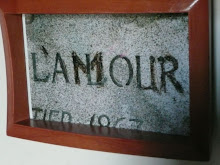
There's a picture frame hanging over my stove containing a photo I took years ago in Montréal. Most apparently, it reads "L'AMOUR." It's easy to take for granted that word in the photo. After all, we're all into love, aren't we? However, upon closer inspection one would see that "L'AMOUR" has been written in marker over another set of letters which have been engraved in the stone. This other word is "LA LOI," which in French means "the law."
The person who defaced (I use the term loosely here) this piece of public property seemed to have seen 'love' in everything, even in this hackneyed term etched into a slab of marble. Somehow, I think therein lies a message for us: that love is in all things, that there must be love in all things. And that's the law.
This blog is a record of my research into the presence of love in all things, especially in people, art, and, although I reside in the American urban jungle, Nature.
Thanks for visiting.
The person who defaced (I use the term loosely here) this piece of public property seemed to have seen 'love' in everything, even in this hackneyed term etched into a slab of marble. Somehow, I think therein lies a message for us: that love is in all things, that there must be love in all things. And that's the law.
This blog is a record of my research into the presence of love in all things, especially in people, art, and, although I reside in the American urban jungle, Nature.
Thanks for visiting.
Subscribe to:
Comments (Atom)