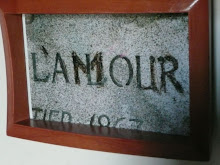
What happens to the artist when he doesn’t get to create his art? When he represses his creativity? For the artist, his art is his voice. It is means of self-expression, the one most natural and most unique to him. I often think about the frustration that the artist who’s – for any number of reasons – is unable to use his voice. He’s mute. Although he may have convinced himself and others that he doesn’t really have the ability, the artistic ability, in his heart of hearts he knows he does, or, at least has some curiosity to discover whether he does.
I think there’s no one more easily convinced of one’s lies than the liar himself. We are easily given to believing our own lies. We want to; it seems to make life easier when we do. Life is more difficult for those who see the world differently from the others. It requires some effort and strain to challenge established structures, habits, and notions. It’s disheartening to endeavour toward something no one else but you can else envision.
Let’s say the artist suppresses his voice and he finds he’s doing so successfully: he’s lost the urge and any skill he might have had, which further confirms his belief that he’s not an artist. But, I think, what the artist doesn’t realize is that the impulse to create is not his to control. It is an energy, a force, that has a life of its own. He is the vessel, the conduit for this creative force. His body, his heart, and his mind are the medium for this energy in this world. The force is of other-worldly provenance.
Bottled up within an earthen vessel the other-worldly force churns. Like a tornado, which draws more and more energy to itself as it spins within the vessel that is the unexpressed artist, until finally it bursts forth, causing destruction to anything around it, or, at the very least, to the human vessel within which it was contained. One possible example of the former scenario is Adolf Hitler. He’s extreme. As a result of his repression of his artistic energy, he became frustrated, which turned to despondence, which in turn became anger which turned into hatred.
Examples of the latter scenario – of the artistic forced-turned-self-destructive – is all too common. We know many of these lost artists. Regardless of what they do for a living, ie. working a bank or some other corporation, you can spot them by how well they compose a photograph, for instance. Or they way the put flowers together. Or the color of socks they choose. Or the shape of their glasses. Or by how much they like to sing. Or doodle. Or dance. These lost artists will reveal only very small and seemingly insignificant hints like these. It’s within these miniscule corrals that they have let themselves run amok. They have told themselves and others that these perversions from the ordinary and merely “hobbies, but nothing they take seriously.”
Hobbies are things we enjoy doing but which we have restricted ourselves from completely indulging in. I don’t think that, by nature, there really are such things as hobbies. The notion of the ‘hobby’ is something we came up with to excuse ourselves for giving into a day-to-day that we hate, a lifestyle that goes against our nature. If we enjoy doing something, love something, or are good at something it’s for a reason.
Unfortunately, sometimes you can also spot the lost artist, the closeted artist, by how much the person drink, or how often he does drugs, or loses himself in some other addiction, i.e. to money, to fame, to shopping, etc. (Edie Sedgwick immediately comes to mind right now only because I saw Factory Girl last night.)
Showing posts with label creativity. Show all posts
Showing posts with label creativity. Show all posts
Thursday, October 22, 2009

Monday, October 5, 2009
Laziness: How we sometimes get ourselves into trouble
Everyone has the capacity for wisdom, “common sense”, or discernment. The lack of these things is borne out of the condition of laziness which I prefer to call ‘sloth’. For me, sloth connotes mental laziness rather than physical laziness. Someone who is a jetsetter, or highly productive, or simply very busy, can be mentally lazy or sloth. Through popular perception – possibly a perception skewed by Judeo-Christian values, such as the Protestant Work Ethic - the extremely busy, highly productive jetsetter represents the best component of a well-functioning society. We can produce. We are prosperous. Therefore: we are secure and satisfied.
A person opts for the mode of laziness thinking this is how he will avoid conflict, effort, and suffering. To follow a script or take the prescribed path seems like the easy route to success or, at least, satisfaction. But eventually his laziness and desire to avoid conflict, effort, and suffering gets him into ultimate suffering and dissatisfaction.
The sloth tends to be supremely preoccupied with the appearance of productivity, prosperity and therefore secure. It’s a cover up for his lack of ideas, imagination, and creativity. The sloth lacks ideas, imagination and creativity because he is sloth. He has shut down mentally. For the sloth, the easiest thing to do is to feign. This is where materialism and the preoccupation with consumer products come from. It is easier, first of all, to fall in line and to vigorously perform a script directed by someone or something else, and second of all, to then adorn oneself with the symbols of productivity, prosperity, and therefore security and satisfaction.
There is a certain sense of security – perhaps a true sense of security – that comes out of the acknowledgement of one’s originality and the ability to creative something original. If it’s a true sense of security, it’s because it is self-sustaining. Originating and creating yields confidence (i.e. security), and confidence yields originality and creativity. It’s self-balancing and therefore harmonious, therefore ultimately satisfying.
Not only is the lazy mind prone to assuming pretense, but it is also highly susceptible to buying into pretense. The sloth has surrendered his mind to be informed by any passing whim, fashion, desire, or scheme. The sloth had, at some point, decided that he will no longer think for himself and concede to any (and even, every) prevailing notion presented by another, because it’s more important to appear as though he fits in, as though he understands. It’s not that so much that it is more important to appear as though he understands the world; it’s actually more important to the sloth to do what is easier, and that is, to pretend than it is to be.
It’s always easier to imitate, to follow, to subscribe. It’s also always easier to throw money at something – or someone – than it is to be with that person. To be in love with that person. To be a parent to that person. To be a friend to that person. To be that person.
A person opts for the mode of laziness thinking this is how he will avoid conflict, effort, and suffering. To follow a script or take the prescribed path seems like the easy route to success or, at least, satisfaction. But eventually his laziness and desire to avoid conflict, effort, and suffering gets him into ultimate suffering and dissatisfaction.
The sloth tends to be supremely preoccupied with the appearance of productivity, prosperity and therefore secure. It’s a cover up for his lack of ideas, imagination, and creativity. The sloth lacks ideas, imagination and creativity because he is sloth. He has shut down mentally. For the sloth, the easiest thing to do is to feign. This is where materialism and the preoccupation with consumer products come from. It is easier, first of all, to fall in line and to vigorously perform a script directed by someone or something else, and second of all, to then adorn oneself with the symbols of productivity, prosperity, and therefore security and satisfaction.
There is a certain sense of security – perhaps a true sense of security – that comes out of the acknowledgement of one’s originality and the ability to creative something original. If it’s a true sense of security, it’s because it is self-sustaining. Originating and creating yields confidence (i.e. security), and confidence yields originality and creativity. It’s self-balancing and therefore harmonious, therefore ultimately satisfying.
Not only is the lazy mind prone to assuming pretense, but it is also highly susceptible to buying into pretense. The sloth has surrendered his mind to be informed by any passing whim, fashion, desire, or scheme. The sloth had, at some point, decided that he will no longer think for himself and concede to any (and even, every) prevailing notion presented by another, because it’s more important to appear as though he fits in, as though he understands. It’s not that so much that it is more important to appear as though he understands the world; it’s actually more important to the sloth to do what is easier, and that is, to pretend than it is to be.
It’s always easier to imitate, to follow, to subscribe. It’s also always easier to throw money at something – or someone – than it is to be with that person. To be in love with that person. To be a parent to that person. To be a friend to that person. To be that person.
Subscribe to:
Posts (Atom)